
Contents
What Is the Screaming Condor?
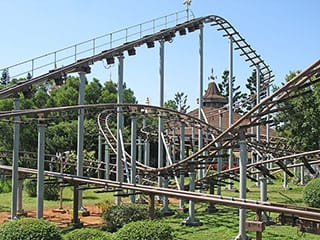
Ask almost anyone who's visited Leofoo Village what image comes to mind first, and they'll describe the same thing: a vivid red track arcing high overhead, carrying riders through loops and inversions at a stomach-dropping pace. That's the Screaming Condor.
The Screaming Condor opened in 1999 as Asia's first U-track Suspended Looping Coaster (SLC) — a distinction that caused a sensation in the theme park world at the time. "Suspended" means the ride vehicles hang beneath the track rather than sitting on top, like a normal train on a rail. The result? Your feet dangle completely in mid-air. There's no floor beneath you, no ground beneath your feet — just the open sky, the blur of the Wild West theming rushing past, and the next inversion coming at you fast.
The "U-track" refers to the coaster's distinctive layout: the overall course traces a shape resembling the letter U, delivering a compact but relentlessly intense sequence of climbs, plunges, and full 360-degree inversions — all within a few breathless minutes. This configuration was genuinely unprecedented in Asian parks when the Screaming Condor debuted.
More than two decades later, the Screaming Condor remains Leofoo Village's defining attraction — the coaster equivalent of Space Mountain at Disneyland, a ride that defines generations of visitors. Every thrill-seeker who steps inside this park eventually ends up in that queue.
Technical Specs & Details
For coaster enthusiasts, the numbers matter. Here are the Screaming Condor's key technical specifications (some figures are approximate — refer to official Leofoo Village data for precision):
| Specification | Data | Notes |
|---|---|---|
| Ride Type | Suspended Looping Coaster | Suspended Looping Coaster (SLC) |
| Top Speed | approx. 80–90 km/h | Peak speed reached at the main drop |
| Maximum Height | approx. 30 m | Distance from ground to highest point |
| Number of Inversions | 6 inversions | Including complete 360-degree loops |
| Maximum G-Force | approx. 4–5G | Difference between top and bottom of loop elements |
| Ride Duration | approx. 90 seconds | Total time from launch to brake run |
| Manufacturer | Vekoma Rides | Dutch amusement ride manufacturer |
| Opening Year | 1999 | First of its type in Asia |
| Minimum Height Requirement | 120 cm | Subject to change — confirm on-site |
What Exactly Is a Suspended Looping Coaster?
On a conventional coaster, the car sits on top of the track — the same principle as a train on a railway. A suspended looping coaster flips that relationship: the car hangs underneath the track, the way a cradle hangs from a beam. This reversal creates several distinct effects:
- Feet fully in mid-air: No floor, no footrest — just open space below your feet. The sensation of height becomes dramatically more visceral
- Free-swinging motion: The car can swing outward through turns rather than being locked to the track plane, creating a richer, more unpredictable physical sensation
- Inversions feel completely different: Going upside down in a suspended car is a categorically different experience from a conventional loop — your spatial orientation is far more scrambled, and the moment of being fully inverted has a particular intensity that even seasoned coaster fans find striking
This is why many riders who've been on dozens of coasters still find their first suspended looping coaster genuinely surprising. The Screaming Condor delivers something that a standard coaster simply cannot replicate.
Full Ride Experience — Queue to Exit
Here's a complete walkthrough of the Screaming Condor experience from the moment you join the line to the moment you step off.
The Queue Area
The Screaming Condor queue runs through the heart of Leofoo Village's Wild West–themed zone. As you wait, the full track is clearly visible overhead — including the cars currently running through loops and diving at full speed. For first-timers, this visual preview is both a psychological test and the best adrenaline appetizer in the park. Watch the expressions of the riders coming off: the gap between "before" and "after" faces is enormously entertaining.
The queue area features safety notices and (where available) a digital display showing current wait times. Use this time to study the track layout — you'll enjoy the ride more if you know what's coming.
Boarding
When your turn comes, staff will help you settle into your seat and secure the over-the-shoulder harness — a padded restraint that presses forward over your shoulders to lock your upper body in place during the inversions. A few important things to know:
- Glasses, hats, loose phones, and everything else must go into the storage cubby before boarding — absolutely no exceptions
- Staff will physically check every harness is properly locked before dispatch
- If a harness cannot close correctly (usually due to body size), staff will ask you to step off. This isn't personal — it's a hard safety requirement
The Climb: Slow, Deliberate, Terrifying
Unlike coasters that use a pneumatic launch to send you rocketing out of the gate, the Screaming Condor starts with a chain-lift climb — a slow, mechanical ascent that gives you far too much time to think. As the ground falls away and the Wild West zone shrinks into a bird's-eye view, the horizon widens, and you can see the distant mountains framing the park in every direction. These few dozen seconds of quiet, steady climbing are the ride's greatest psychological masterstroke. By the time you reach the top, your heart is already racing — and you haven't gone anywhere yet.
The First Drop: Everything Starts Here
At the crest, the car pauses for just a fraction of a second — and then the bottom drops out. This is the moment every rider remembers most vividly: the near-instantaneous transition from almost-still to 80–90 km/h, the sudden erasure of gravity, the brief, extraordinary weightlessness. Even veterans who've ridden the Screaming Condor twenty times cannot fully suppress their reaction at that first drop. The body just responds.
The Inversion Sequence
The next 90 seconds are a relentless sequence of inversions, high-speed turns, and velocity changes. The Screaming Condor delivers six inversions in total, including:
- Vertical Loop: The classic 360-degree vertical inversion — that two-second period of being completely upside down is the moment most first-timers remember most vividly
- Corkscrew: The car spirals along a helical section of track — a different axis of rotation from the vertical loop, requiring your brain to recalibrate its sense of direction mid-ride
- Zero-G Roll: A special inversion element where you briefly experience near-weightlessness at the top of the roll — a particularly unusual sensation that coaster fans specifically seek out
The sequence moves so fast that there genuinely isn't time to mentally process each element as it arrives. You just experience it. This is actually part of why many people say they "don't know if they liked it until it's over" — the ride simply happens too quickly for real-time analysis.
Braking & Disembarkation
The final brake run brings the car smoothly back to a stop at the station. When you step off, you may notice: rubbery legs (perfectly normal G-force aftereffect), slight shoulder pressure from the harness, and a brief, disoriented "what just happened" feeling. Most people's first reaction isn't fear — it's excitement. The Screaming Condor deposits an unmistakable charge of adrenaline that makes the immediate impulse to join the queue again feel completely logical.
First-Timer's Complete Guide
If you've never been on a suspended looping coaster — or if this is your first time on a high-intensity coaster of any kind — this section is for you.
Three Questions to Ask Yourself Before Queuing
- Are you afraid of heights? — The Screaming Condor's peak is roughly 30 meters, equivalent to a 10-story building. If extreme heights trigger severe discomfort for you, honestly assess your threshold before committing to the queue
- Are you prone to motion sickness from spinning? — Some guests experience dizziness or nausea after rapid rotational elements. If spinning rides tend to affect you strongly, approach the Screaming Condor with that in mind
- When did you last eat? — Allow at least two hours of digestion time before riding. Neither a completely empty stomach nor a very full one is ideal
Mental Preparation That Actually Works
The most effective psychological prep isn't "just tell yourself not to be scared." It's knowing exactly what's coming. You've now read that the Screaming Condor has 6 inversions, hits 80–90 km/h, and lasts about 90 seconds. That information doesn't eliminate every fear — but it dramatically reduces the fear of the unknown, which is usually the most powerful kind.
Practical In-Ride Techniques
- Keep your eyes open: Closing your eyes can actually make you feel worse, because your vestibular system's input no longer matches your visual input. Focus your gaze forward and give your brain a visual anchor
- Relax your shoulders and neck: Tensing up during inversions increases discomfort significantly. Consciously let your shoulders drop and keep your neck loose
- Keep breathing: Many riders instinctively hold their breath during intense moments — this reduces oxygen to the brain and amplifies dizziness. Breathe normally throughout
- Don't fight the G-forces: Let your body move naturally with the car. Bracing against the motion makes the physical sensations harsher
- Scream if you want to: Vocalizing releases tension, and staff and other riders absolutely expect it — and join in themselves
After the Ride
Expect some or all of: wobbly legs, mild head spin, slightly shaky hands. These are standard physiological responses and typically clear up within 5–10 minutes of sitting down in the shade. Don't stack another high-intensity ride immediately afterward — give your body a brief recovery window first.
Height Requirements & Ride Rules
The Screaming Condor has strict boarding rules, all grounded in safety. Here are the main requirements (verify current rules on-site):
| Condition | Rule | Reason |
|---|---|---|
| Minimum height | 120 cm or taller | The harness system is designed for guests of this height and above |
| Pregnancy | Not permitted | G-forces present safety risks during pregnancy |
| Heart conditions | Not advised | High G-forces place significant stress on the cardiovascular system |
| High blood pressure | Not advised | Speed and inversions cause rapid, transient blood pressure fluctuations |
| Neck/back injuries | Not advised | Inversion forces can aggravate existing injury |
| Epilepsy | Not permitted | Rapid visual changes and flashing light exposure may trigger episodes |
A note on body size: the Screaming Condor's over-the-shoulder harness has dimensional limits. Larger-bodied guests may find the harness cannot lock correctly. In that case, staff will politely ask you to disembark — this is purely a safety protocol, not a personal judgment.
Queue Wait Times & Best Strategies
The Screaming Condor consistently records the park's longest queues — it's the most sought-after ride at Leofoo Village, and the weekend crowds reflect that.
| Time Slot | Day Type | Estimated Wait | Recommendation |
|---|---|---|---|
| First hour after opening (9:30–10:30) | All days | 10–20 min | Golden window — go here first |
| 10:30 a.m.–12:00 p.m. | Weekday | 20–35 min | Acceptable |
| 12:00–2:00 p.m. | Weekend | 50–80 min | Avoid if possible |
| 3:00–5:00 p.m. | Weekend | 30–50 min | Slightly better than midday |
| Lunch hour (12:00–1:30 p.m.) | Weekday | 15–25 min | Surprisingly good window |
| Last 30 min before closing | Any day | May be 0 (queue closed) | Watch the closing time carefully |
Three Most Effective Strategies
- Sprint to the Screaming Condor at opening: This is the single most reliable move. When the park opens, most guests linger near the entrance to take photos, check maps, and get oriented. Experienced Leofoo visitors head directly to the Wild West zone at full speed. The first hour sees waits of just 10–20 minutes on almost any day of the year.
- Ride during lunch hour: From about noon to 1:30 p.m., the majority of guests are eating. Crowds at the Screaming Condor drop noticeably. You might sacrifice your own lunch break, but you get a much shorter wait in exchange.
- Express Pass: On weekends with limited time, the Express Pass service can dramatically reduce your wait at the Screaming Condor (see our complete Express Pass guide).
How It Compares to Other Coasters & Rides
Leofoo Village has multiple high-intensity attractions. Here's how the major ones compare, to help you prioritize and understand where the Screaming Condor sits in the park's lineup:
| Ride | Type | Thrill Level | Inversions | Good for Beginners? |
|---|---|---|---|---|
| Screaming Condor | Suspended Looping Coaster | ★★★★★ | 6 inversions | Not as a first coaster |
| Volcano Adventure | Water Coaster | ★★★★☆ | None | Relatively beginner-friendly |
| Sultan's Adventure | River Rapids | ★★★☆☆ | None | Yes |
| Arabian Palace rides | Spinning rides | ★★☆☆☆ | Some rotation | Very much so |
The Screaming Condor in Taiwan's Coaster Landscape
For coaster enthusiasts, the Screaming Condor occupies a unique position in Taiwan's theme park geography. While parks like Six Flags and Universal Studios offer larger and newer coasters, the suspended design remains a genuinely uncommon experience that even frequent park-goers find distinctive.
Compared to other options in Taiwan:
- The suspended SLC design delivers a "feet dangling in mid-air" sensation that conventional coasters simply cannot replicate — it has an enduring draw for Taiwan's local thrill-seeker community
- The maintenance record is solid; years of regular servicing have kept the ride running at a consistently high standard
- Compared to newer coasters elsewhere, the speed figure is not record-breaking — but the density of 6 inversions packed into 90 seconds leaves a strong impression regardless
The Art of Seat Selection
If you have the opportunity to choose your seat, the position matters — quite a lot, actually.
Front Row
Front row gives you the best unobstructed view — nothing blocking your sightline on the drop, no car ahead of you as you enter inversions. The impact of the first drop is maximally direct here. However, because you can see every upcoming element clearly in advance, the psychological pressure is also at its highest. Front row is the ideal choice for experienced riders who want maximum intensity; for first-timers, it may amplify anxiety rather than excitement.
Back Row
Here's the back row secret: because the rear cars are being "whipped" by the momentum of the cars ahead, the speed sensation in the back is often stronger than the front — especially on the big drop, where back-row riders experience an emphatic "being yanked over the edge" feeling that front-row riders don't get. Many coaster regulars swear by the back row for exactly this reason.
Middle Rows
The middle rows average out the experience — neither the unmatched view of the front nor the extra speed kick of the back. For first-timers who aren't sure what they want, middle rows are the sensible default.
Insider Tips: Details That Elevate the Experience
The Screaming Condor's most unforgettable moment isn't the speed or the inversions — it's those few seconds at the very top of the lift hill. The chain has dragged you up slowly, the car sits at the apex, and for one suspended instant you can see the entire park reduced to a miniature below you, the mountains and sky stretching out in every direction. Then everything disappears in one second. That contrast — from absolute stillness to full speed — is an experience that no description fully captures. You just have to feel it.
If you feel dizzy after stepping off, don't immediately drink large amounts of water or eat. Find a shaded spot and sit quietly, letting your body's vestibular system recalibrate on its own — this usually takes 5–10 minutes. If the dizziness persists beyond 20 minutes or is accompanied by nausea, head to the park's first aid station and ask a staff member for assistance.
The single most common reaction after the Screaming Condor is "again!" That impulse is completely understandable. But if the first ride left you feeling even slightly off, rest for at least 30 minutes before deciding whether to go again. Back-to-back rides can compound the G-force effect on your body, and what was mild discomfort the first time may become genuine queasiness the second time around.
Storage cubbies at the Screaming Condor entrance are typically free to use (no coin required — but verify this on the day). Before you board, put everything in: hats, glasses, earphones, loose change, keys, phones, anything that has the slightest possibility of becoming airborne. At 80 km/h through six inversions, a falling object doesn't just become your loss — it becomes a safety hazard for everyone below. Zero exceptions on this one.
Related Guides
💦 Sultan's Adventure
Leofoo Village's other must-ride — a river rapids experience that guarantees a thorough soaking. Complete guide inside.
🏚️ Tombstone Town Ghost Town
Another must-visit in the Wild West zone — the spooky ghost town experience, fully explored.
⚡ Express Pass Guide
The Screaming Condor has the park's longest queues. Is the Express Pass worth it? All the details here.
🎡 Complete Ride Rankings
Every ride at Leofoo Village ranked by thrill factor, with queue time estimates for each.
Frequently Asked Questions
According to official Leofoo Village information, riders must be at least 120 cm tall to board the Screaming Condor. Guests with heart conditions, high blood pressure, epilepsy, neck or back injuries, or who are pregnant are not advised to ride. Always check current on-site signage for the most up-to-date requirements.
The Screaming Condor is one of Leofoo Village's most intense rides and ranks as a high-difficulty roller coaster. If you have never ridden a coaster before, starting with the Screaming Condor is not recommended — the suspended design leaves your feet dangling in mid-air, and combined with 360-degree loops, the intensity can be overwhelming for true beginners. Try some of the park's milder rides first, then work up to the Screaming Condor.
The Screaming Condor typically has the longest queue in the park. On weekends, expect 60–90 minutes; on weekdays, usually 25–45 minutes. The most effective strategy is heading there immediately after the park opens — during the first hour, the wait is typically only 10–20 minutes.
Yes. The Screaming Condor opened in 1999 as Asia's first U-track Suspended Looping Coaster (SLC). Its defining feature is that the ride vehicles hang beneath the track rather than sitting on top — leaving riders' feet completely off the ground — and complete full 360-degree loops. This design was exceptionally rare in Asian theme parks at the time, and it made the Screaming Condor an instant icon for Leofoo Village.
The Screaming Condor reaches a top speed of approximately 80–90 km/h, with a maximum G-force of around 4–5G (experienced when accelerating through the loop inversions). That level of G-force is the equivalent of your body weight multiplying by 4–5 in an instant — one of the most memorable sensations in roller coaster riding. Refer to official Leofoo Village specs for precise figures.
Before boarding, secure all loose items — hats, glasses, phones, keys, and anything that could fall — in the provided storage cubbies or hand them to someone waiting outside. Wear comfortable clothing, fasten your restraint harness properly, and follow all staff instructions. If you feel dizzy after the ride, sit down in a shaded area, rest, and drink water. Avoid jumping straight onto another high-intensity attraction.